

New Full Lineage Primary Bone Cells: Cloud-Clone Covers 10 Species to Streamline Bone Disorder Translational Research
High-Fidelity Primary Cells with Dual QC: Solve Reproducibility Bottlenecks for Orthopedic, Regenerative & Veterinary Drug R&D
HUSTON, TX, UNITED STATES, August 17, 2026 /EINPresswire.com/ -- The global burden of skeletal diseases keeps expanding year by year. World Health Organization data shows osteoporosis affects roughly 200 million women worldwide, while osteoarthritis plagues more than 500 million people. With the growing population of sports enthusiasts and aging companion animals, demand for tendon injury treatment and veterinary orthopedic surgery rises at an annual rate exceeding 15%. This trend has turned research directions including bone metabolism mechanisms, anti-osteoporosis pharmaceuticals, bone repair biomaterials and tissue engineering into high-growth hotspots across the biotech industry.
However, conventional immortalized cell lines present prominent limitations for laboratory research. Such cell models feature missing key signaling pathways, drifting gene expression profiles and inconsistent drug response curves, which generate unrepeatable experimental data and create major obstacles for preclinical translational studies. In contrast, primary cells isolated directly from living tissues fully retain donors’ genetic backgrounds, epigenetic modifications and native physiological functions. Top-tier journals such as Nature, Science and Cell, together with new drug evaluation guidelines issued by the FDA and NMPA, uniformly recognize primary cells as the gold-standard in vitro research model for all bone-related disorders.
Drawing on nearly two decades of experience in primary cell research and development, Cloud-Clone has completed a strategic upgrade to its bone primary cell product line. Cloud-Clone has built a comprehensive resource matrix covering 16 specialized bone cell types across 10 experimental species: human, mouse, rat, rabbit, canine, porcine, ovine, feline, guinea pig and chicken.
The upgraded portfolio systematically includes all core functional cells involved in bones, cartilage, intervertebral discs, tendons, synovium and bone marrow immune microenvironments, divided into six dedicated research modules to match diverse laboratory objectives. For cartilage and joint injury research, articular chondrocytes (AC) serve as core screening models for anti-osteoarthritis drugs and cartilage metabolism mechanism studies; meniscal fibrocartilage cells (MFC) support experiments on meniscus damage and biomechanical repair. Auricular and tracheal chondrocytes separately facilitate facial tissue reconstruction and respiratory cartilage lesion research, covering all experimental requirements for elastic and hyaline cartilage research. For degenerative spinal disorder research, annulus fibrosus cells (AFC) and nucleus pulposus cells (NPC) form a matched model system that accurately simulates annulus rupture and nucleus pulposus dehydration degeneration, functioning as an indispensable in vitro tool for spinal regenerative therapy and intervertebral disc repair material development. For rheumatoid arthritis and joint microenvironment research, synovial fibroblasts respond robustly to inflammatory stimuli including TNF-α and IL-1β, releasing abundant pro-inflammatory factors and matrix metalloproteinases to faithfully recapitulate pathological processes of synovial hyperplasia and cartilage erosion. Synovial mesenchymal stem cells (SMSC) possess strong chondrogenic differentiation capacity alongside immunomodulatory properties, making them ideal seed cells for articular cartilage regeneration. For osteogenesis and bone defect repair research, osteoblasts (OB) are directly applied to assess osteogenic activity in osteoporosis, non-union fracture and tumor bone metastasis studies. Bone marrow mesenchymal stem cells (BMMSCs), the core seed cells for regenerative medicine, are widely used to validate osteogenic/chondrogenic differentiation and novel exosome therapeutics. Periosteal stem cells (PeSC) deliver superior osteogenic induction efficiency, suitable for vascularized bone tissue engineering and large-area bone defect restoration. For tendon and ligament injury repair research, tenocytes (TC) enable mechanistic analysis of tendinitis and fibrotic degeneration. Tendon-derived stem cells (TDSC) display outstanding mechanical responsiveness, supporting the development of stretch-resistant tendon biological grafts and filling the gap of seed cell resources in tendon tissue engineering. For bone immunity and systemic bone disorder research, bone marrow mononuclear cells (BMMC) reconstruct the interactive microenvironment between intraosseous immune cells and stem cells. Bone marrow-derived macrophages (BMDM) differentiate into mature osteoclasts under RANKL induction, acting as critical research tools for osteoporosis, inflammatory osteolysis and tumor bone resorption mechanisms.
Poor batch-to-batch consistency, hidden microbial contamination and insufficient cell viability are the three most common pain points limiting primary cell applications, frequently leading to irreproducible lab results. Cloud-Clone has constructed a closed-loop quality control system covering raw material sourcing to finished cell products, implementing dual strict quality barriers to resolve this widespread industry challenge. At the sourcing stage, all animal-derived cells are harvested from
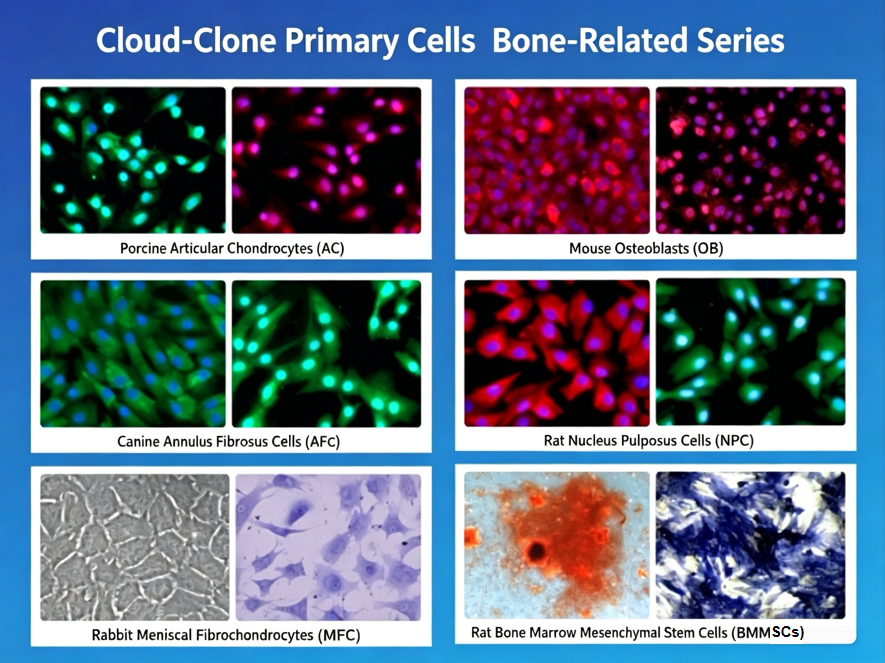
Cloud-Clone’s fully compliant SPF laboratory animal facility with complete breeding and production permits. Laboratory animals are raised in full barrier environments and regularly screened for viruses, mycoplasma and pathogenic bacteria. Licensed veterinarians perform standardized tissue dissection to precisely isolate target tissues and eliminate interference from miscellaneous connective tissue, maximally preserving native cell viability. At the cell preparation stage, all cell isolation and purification procedures are carried out in GMP-compliant production workshops. Optimized proprietary enzymatic digestion and density gradient centrifugation protocols minimize the proportion of contaminating cells. Every batch of finished cells undergoes four standardized pre-delivery inspections: microscopic morphological identification, specific biomarker validation via immunofluorescence, flow cytometry or special staining, proliferation activity evaluation, and biosafety screening that confirms negative test results for mycoplasma, endotoxins, fungi and bacteria. This multi-layer inspection framework fully guarantees consistent cell phenotype, high viability and complete biological safety.
Figure 1 Identification Diagram of Cloud-Clone Bone-Related Primary Cells
To help researchers select optimal cell combinations aligned with their research aims, Cloud-Clone has designed modular selection packages targeting four mainstream research fields to lower trial-and-error costs. For basic medical mechanistic research, a two-tier strategy combining high-throughput screening using rodent cells followed by validation with human primary cells is recommended. Researchers first identify molecular targets via gene knockout and pathway screening in mouse and rat cell models, then verify cross-species conservation using human cells to avoid translational failures between animal experimental outcomes and human physiology. For veterinary and companion animal orthopedic drug development, skeletal metabolic pathways in cats and dogs differ drastically from humans, requiring species-matched primary cells for efficacy evaluation. Feline synovial cells exhibit high sensitivity to inflammatory cytokines, ideal for screening anti-inflammatory biological agents, while canine articular chondrocytes enable assessment of chondrotoxicity of nonsteroidal anti-inflammatory drugs. Combined with canine bone marrow stem cells, these cells build a complete in vitro evaluation platform for companion animal bone disorder therapeutics. For regenerative medicine and preclinical translational research using large animal models, porcine and ovine weight-bearing joints share highly similar physiological structures with human joints. Their chondrocytes and tenocytes represent the optimal model to test biocompatibility and mechanical performance of biological scaffold materials. Matched stem cells from the same species further validate directional differentiation capacity, generating reliable preclinical in vitro data for new pharmaceutical and medical device registration and drastically cutting costs of subsequent in vivo animal trials. For osteoporosis, tumor bone metastasis and inflammatory bone disease research, a triple cell co-culture system of osteoblasts, immune cells and osteoclast precursors is advised. Osteoblasts measure bone-forming effects of candidate compounds, bone marrow mononuclear cells reconstruct intraosseous immune cell crosstalk, and bone marrow macrophages establish a bone resorption functional assessment platform to comprehensively analyze how test agents regulate overall bone homeostasis.
Unlike most suppliers that only offer rodent and human primary cells, Cloud-Clone’s expanded product line covers model organisms including rabbits, canines, pigs, sheep, cats, chickens and guinea pigs, fully meeting cutting-edge research demands in comparative medicine, companion animal healthcare and livestock orthopedics. Its exclusive supply of feline chondrocytes and synovial primary cells has gained wide recognition from veterinary research teams globally.
Additionally, Cloud-Clone holds full international export qualifications, enabling stable global shipment to laboratories worldwide. Customized one-stop technical services including targeted cell isolation, cell expansion and disease in vitro model construction are also available, covering all research stages from fundamental mechanism exploration to preclinical efficacy evaluation. To date, Cloud-Clone has developed more than 560 primary cell products with over 3,000 standardized cell lines in stock, covering all categories of stem cells, immune cells and tissue-specific functional cells.
Breakthroughs in skeletal disease research rely fundamentally on cell models that faithfully replicate native physiological conditions. Cloud-Clone’s full-spectrum bone primary cell library spanning ten species and sixteen cell subtypes leverages self-controlled animal sourcing and pharmaceutical-grade quality control standards to deliver high-fidelity, stable in vitro research tools for scientists across the globe. The integrated product ecosystem eliminates translational barriers throughout the full research pipeline, spanning basic mechanistic studies, large-animal preclinical testing and new drug candidate evaluation. With Cloud-Clone’s standardized primary cell solutions, every dataset delivers repeatable results, bringing all research discoveries closer to successful clinical translation.
About Cloud-Clone Corp.
Cloud-Clone Corp. is dedicated to the development and production of high-quality immunoassay reagents and detection solutions. With a focus on antibody engineering, multiplex assay development, and cross-platform compatibility, the company provides research tools designed to support precision medicine and advanced biomedical investigation globally. Our core products and services include the research and development of proteins, antibodies, ELISA kits, primary cells, and multiplex cytokine assay kits, as well as professional CRO services to fully meet the diverse needs of biomedical research and related fields.
For more information about Cloud-Clone Corp, visit www.cloud-clone.com.
CLOUD-CLONE CORP.(CCC)
Tel: 001-832-538-0970, 0086-27-8425-9552
Email: mail@cloud-clone.com, sales@cloud-clone.us
Visit us on social media:
LinkedIn: https://www.linkedin.com/company/cloud-clone-corp/
Instagram: https://www.instagram.com/cloudclonecorp2023/
TickTok: https://www.tiktok.com/@cloudclonecorp2026
SuKi Duan
CLOUD-CLONE CORP.WUHAN
email us here
Visit us on social media:
LinkedIn
Instagram
TikTok
X
Legal Disclaimer:
EIN Presswire provides this news content "as is" without warranty of any kind. We do not accept any responsibility or liability for the accuracy, content, images, videos, licenses, completeness, legality, or reliability of the information contained in this article. If you have any complaints or copyright issues related to this article, kindly contact the author above.
